


First, a few notes on the process
Sheesh, it really is so hard to get people to do anything online. (I know I’m not alone in that!) I sent this survey to 50 people and got 5 responses. A 10% response rate isn’t bad, but I’d love to grow it next time, and I’m excited to experiment with how.
We’ll run a survey like this once per season, so if there’s someone in your life whose perspective would add to the mix (hint hint), please pass this issue along to them.
Chart 1 takeaways
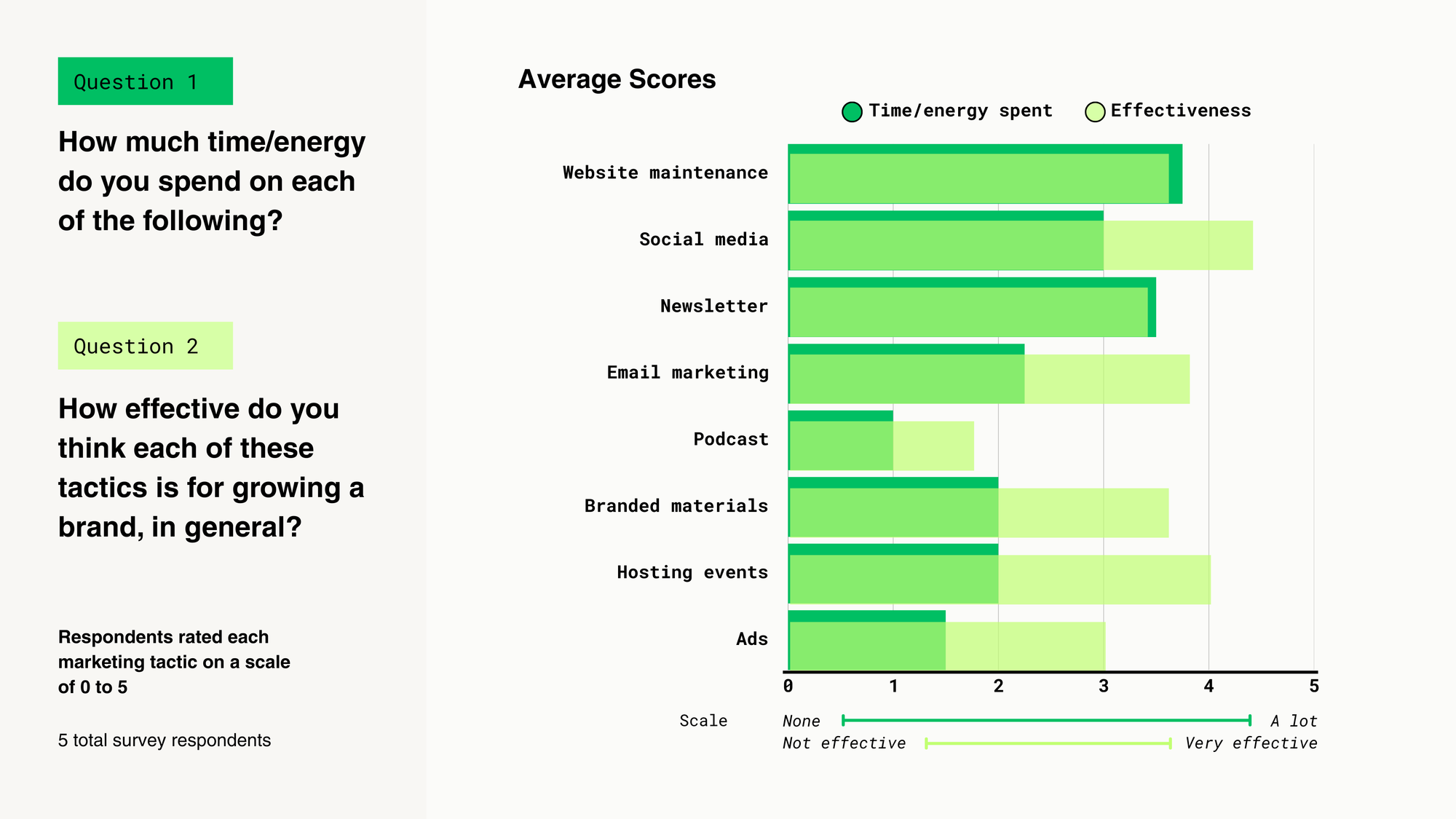
Most people understand that different marketing tactics can be effective — the real barrier is time. No surprise there. We’re all busy, and marketing often has to fit into the margins.
Websites require a lot of effort, sometimes more than they should. The high website numbers make sense: a solid website is non-negotiable. And the people who responded to this survey are likely actively refining their brands and figuring out their positioning. In an ideal world, your website wouldn’t be your most time-consuming task — but during that “figuring it out” phase, it often is.
Social media ranks as the most effective tactic overall. It offers a lot of visibility without demanding huge budgets or resources. Hosting events was close behind (more on that later). Websites, newsletters, emails, and brand materials all clustered together, suggesting something important: while each element matters, it’s the combination that creates a strong brand presence. To be “good,” you need to show up in multiple places — even if the data also suggests we’re all a bit underachieving there (because perfection isn’t realistic).
Chart 2 takeaways
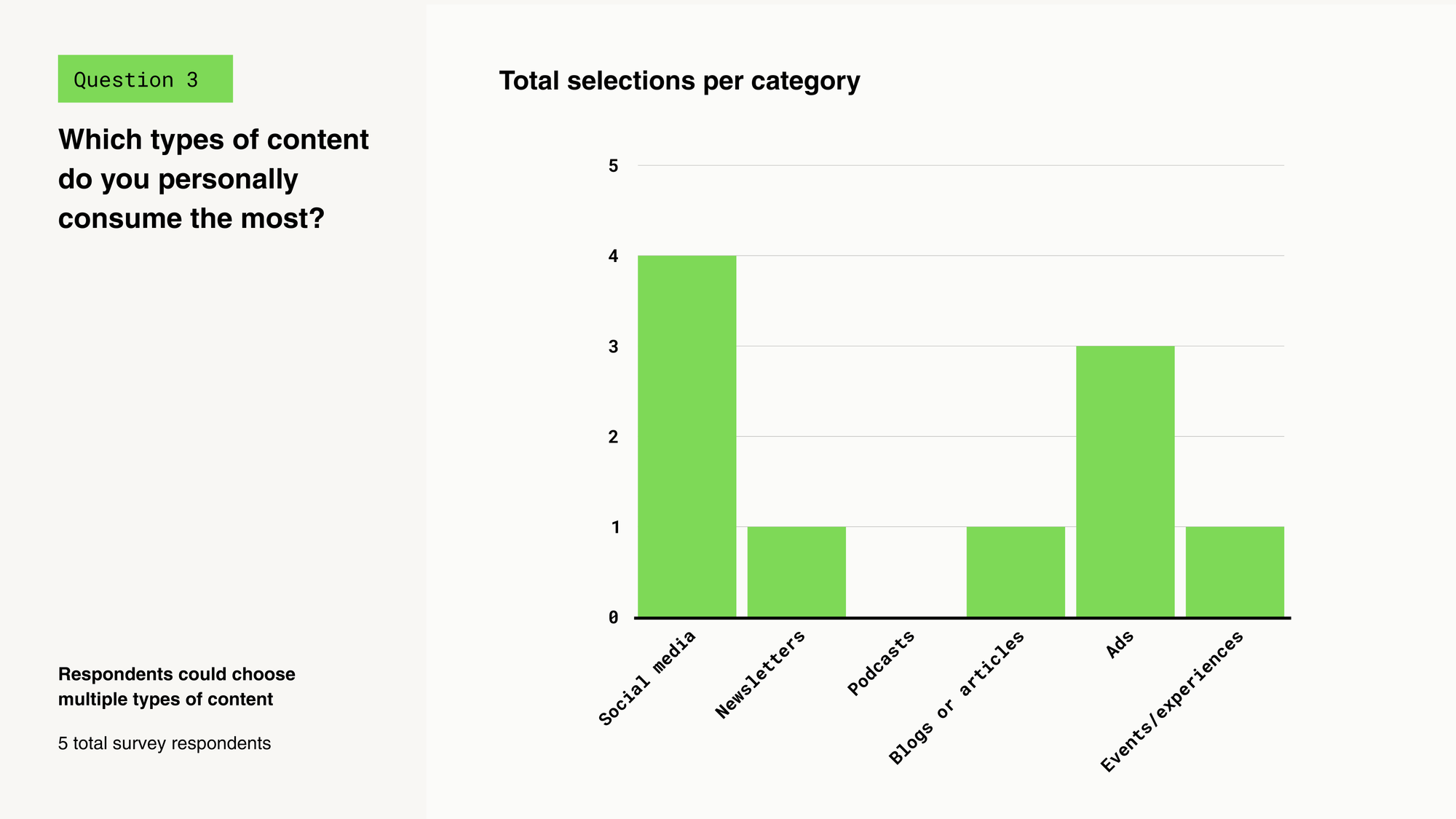
Advertising may be an underexplored opportunity for small brands. It’s the second most-consumed type of content after social media, and both sit well above the rest. Yet in Chart 1, respondents said they spend very little time on ads. That gap raises an interesting question: could small brands be leveraging advertising more thoughtfully?
Social media being the most consumed makes sense. We all have limited time and a lot to keep up with, so the content that wins is quick and easy to consume. At this point, it’s also rare to find someone who isn’t on at least one platform.
The lower numbers for newsletters and podcasts reflect capacity, too. People can only commit to a small number of things that require sustained attention. And with celebrities and major brands dominating those spaces, it’s harder for smaller brands to break through.
Events are a special case. The data doesn’t fully capture their outsized impact. Even though we attend relatively few events, showing up in person signals a deep connection already exists. And as Chart 1 showed, we still perceive events as highly effective. So while they may rank lower here, they’re still powerful — just in a different way.
What we can do with the data
If a tactic isn’t widely consumed, it probably shouldn’t take up a disproportionate amount of your time.
Websites, podcasts, and newsletters can easily become time sinks (I’m speaking from experience here). Find ways to make them easier to produce so you can spend more time on higher-visibility work.
The same goes for events. Don’t do them often. Events aren’t about broad awareness — they’re about deepening relationships with the people who already love you. Make them great. Those people deserve it. Then give yourself a break.
Spend most of your limited time on the things people engage with the most:
- A website that clearly represents who you are. Get it solid, then move on.
- A presence on two (or so) social platforms to stay visible and connected.
- A small set of branded materials. These only need to be made once, but their payoff can be huge: a sweatshirt or hat, a window poster, eye-catching signage, a well-placed neighborhood banner. (They still need to be done well — don’t just slap a logo on something.)
One last consideration:
Could a small, thoughtful advertising effort help carry your brand further into the world? Not big, flashy buys — but modest ones. An ad in a local publication. Sponsoring a newsletter or podcast. A partnership with a local creator. Even Google or Meta ads, approached experimentally. Try one thing and see what you learn.
Those are the thoughts that came up for me while looking at the data. I’d love to hear what stood out to you, too. Feel free to leave a comment on the site.
Comments