
As I write this, I’m literally WOOP WOOOOP’ing because we finally put in a new doorway between our kitchen and dining room. If you remember, I wrote about that horrible wall in one of the first issues of Tincan, as some sort of stand-in for the tension that so many projects create: wanting everything figured out from the start versus just getting going and trusting it will work itself out. That doorway project sat on our list for years. Low priority, big impact. But now, instead of taking an absurd number of 90-degree turns to get food to the table, you can walk in a reasonably straight line. Friends call it “the expressway.” My favorite reaction is still: “Oh, I thought it was always like this.” Every time, I’m giddy.
The real test was a party. People gathered in the kitchen like they always do, but then they drifted. If they came back, it was because they wanted to, not because they were trapped. That’s what success feels like: ease you barely notice once it’s there.

I have a long list of projects like that doorway, in work and in life. I always think checking them off will fundamentally change things. And it does! Briefly. Then new priorities appear. New doorways.
We’re all doing this for ourselves and for the brands we manage: working toward moments that feel perfect, even if only for a minute. Clearing the slate. Making a new list. If the last year taught us anything, it’s that none of us can predict what comes next.
So best of luck to you in setting your new list of priorities for the year. And good luck to you again in two months when everything changes and you have to rewrite it all. It’s kinda wonderful that we get to be so untethered.
Small Brand Notes
- Sunwoven’s refreshingly vague yearly goals
“Land 2 big projects” and “Make more money.” No rigid benchmarks, just a direction. That kind of looseness feels far more realistic for small business owners whose priorities shift constantly. - The server’s message at Thai Diner
On a recent NYC trip, Alyssa and I finally made it to Thai Diner. The food ruled, obviously, but what stuck with me was our server. When we asked for favorites, he named a few dishes, then shrugged and said, “Everything is good. Trust your gut.” That kind of confident, agency-granting nonchalance stuck with me. When we communicate — online, in our copy, or one-on-one — we can either create more uncertainty or help people feel capable and steady. Let’s aim for the latter in 2026.
Last Month’s Survey Results
First, a few notes on the process
It really is so hard to get people to do anything online. I sent this survey to 50 people and got 5 responses. A 10% response rate isn’t horrible, but I’d love to grow it next time, and I’m excited to experiment with how.
We’ll run a survey like this once per season, so if there’s someone in your life whose perspective would add to the mix (hint hint), please pass this issue along to them.
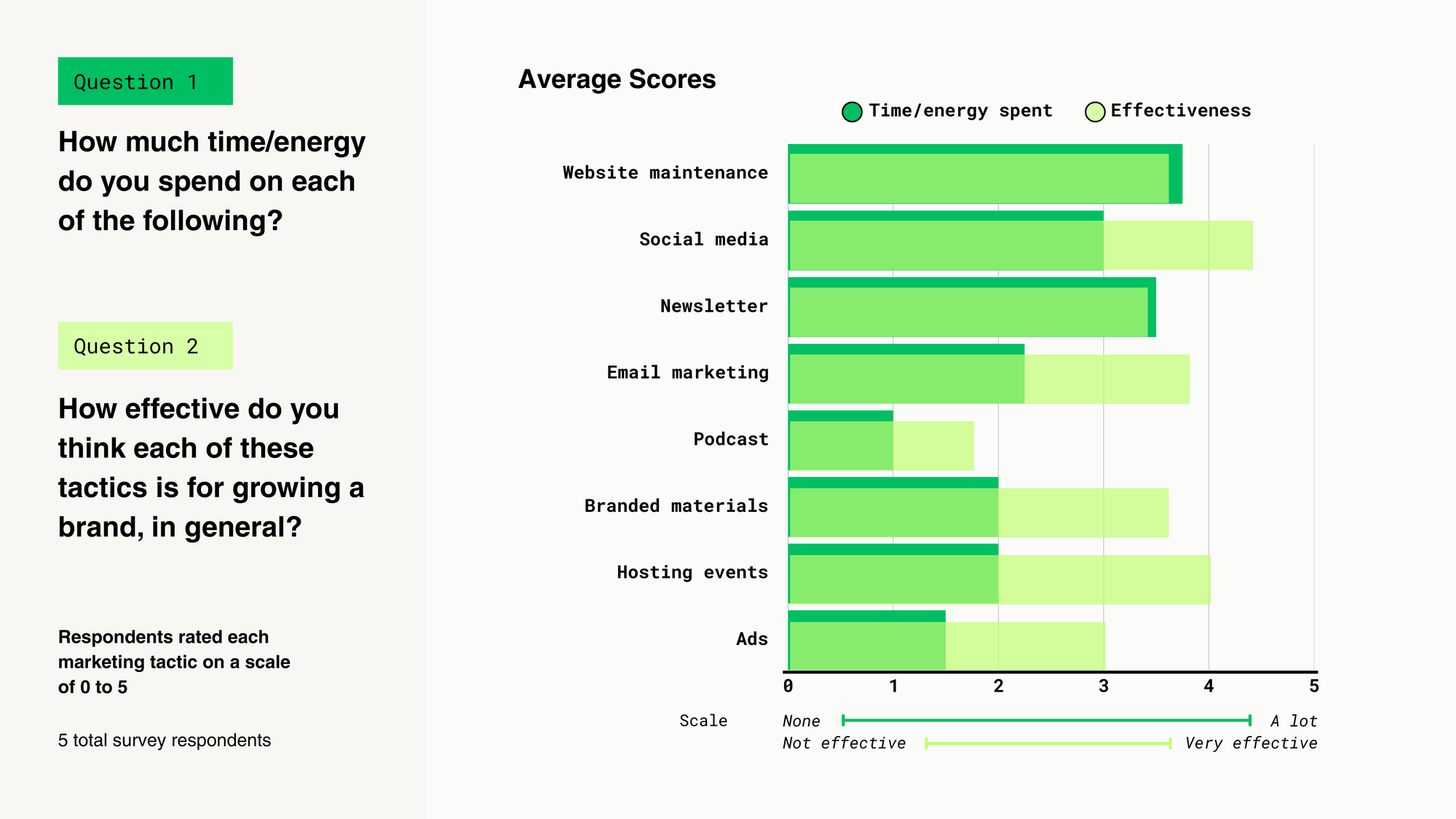
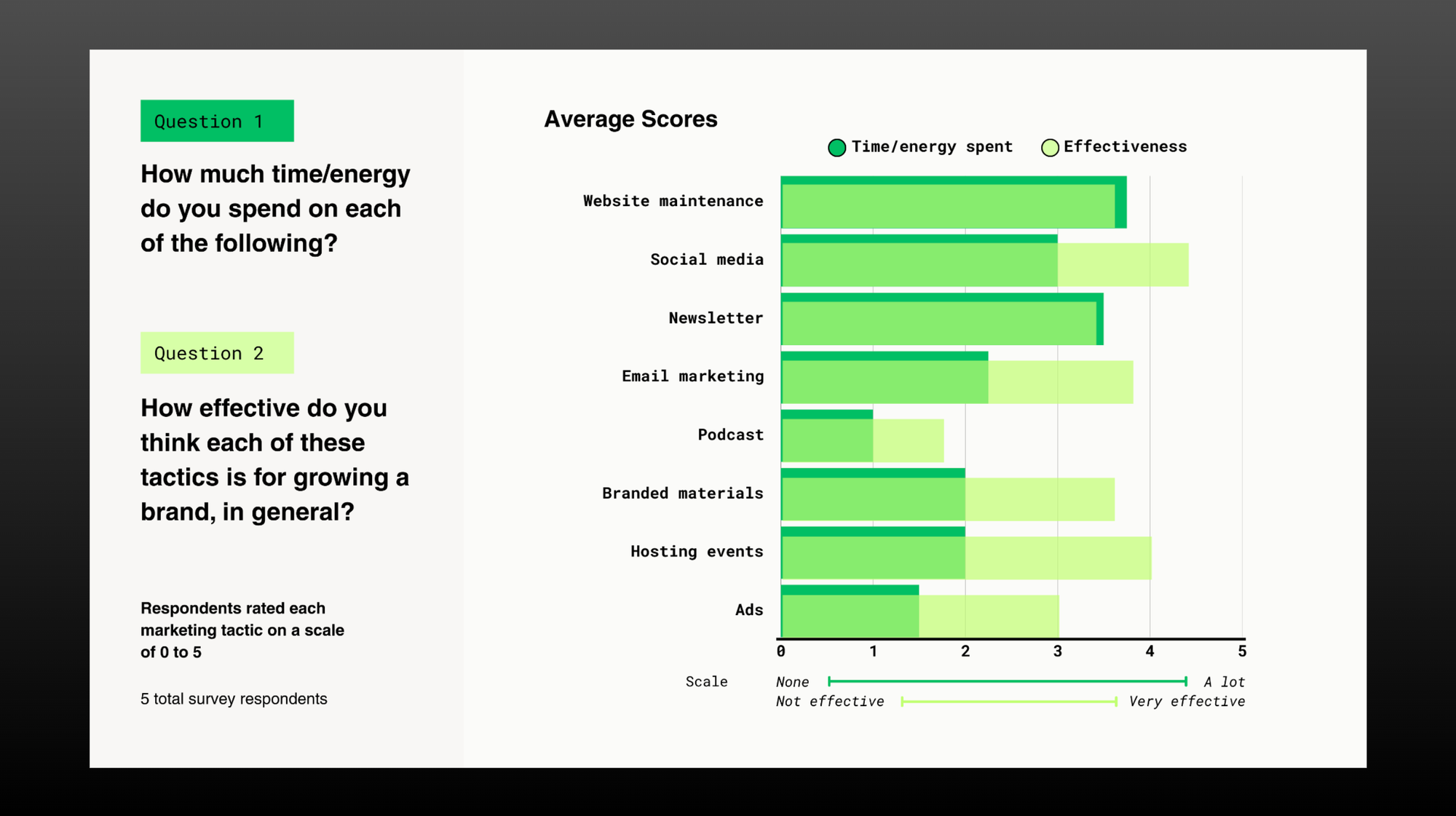
Websites require a lot of effort, sometimes more than they should. The high website numbers make sense: a solid website is non-negotiable. And the people who responded to this survey are likely actively refining their brands and figuring out their positioning. In an ideal world, your website wouldn’t be your most time-consuming task. But during that “figuring it out” phase, it often is.
Social media ranks as the most effective tactic overall. It offers a lot of visibility without demanding huge budgets or resources. Hosting events was close behind (more on that later). Websites, newsletters, emails, and brand materials are all clustered together, suggesting something important: while each element matters, it’s the combination that creates a strong brand presence. To be “good,” you need to show up in multiple places.
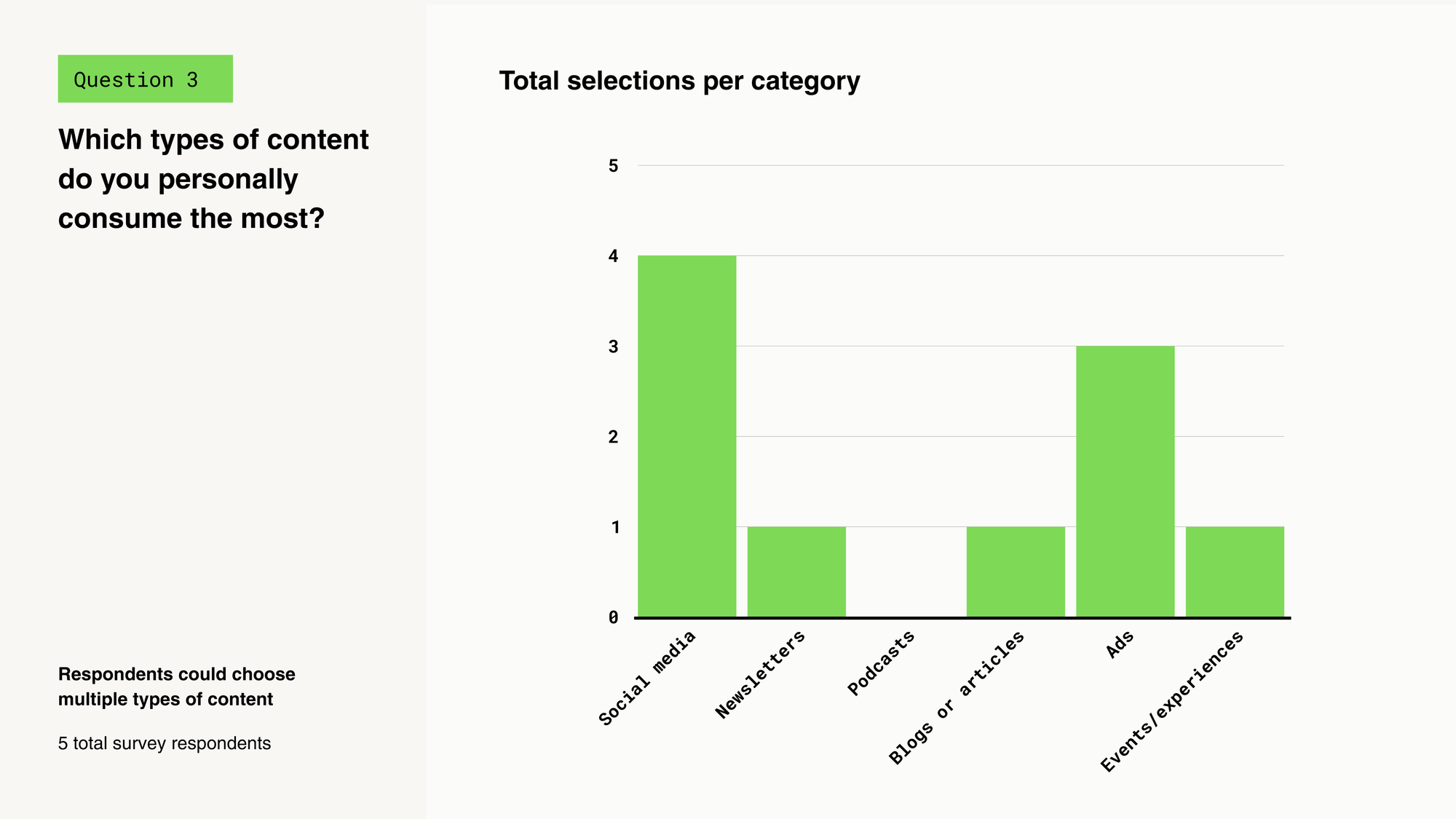
Advertising may be an underexplored opportunity for small brands.
It’s the second most-consumed type of content after social media, and both sit well above the rest. Yet in Chart 1, respondents said they spend very little time on ads. That gap raises an interesting question: could small brands be leveraging advertising more thoughtfully?
Social media being the most consumed (chart 2) makes sense. We all have limited time and a lot to keep up with, so the content that wins is quick and easy to consume. It’s also rare to find someone who isn’t on at least one platform.
The lower numbers for newsletters and podcasts (chart 2) reflect capacity, too. People can only commit to a small number of things that require sustained attention. It's also worth noting that celebrities, established creators, and major brands now totally dominate those spaces too, which makes it hard for smaller brands to compete for attention.
Events are a special case. The data doesn’t fully capture their outsized impact. Even though we attend relatively few events, showing up in person signals that a deep connection already exists. And as Chart 1 showed, we still consider events to be highly effective. So while they may rank lower here, they’re still powerful — just in a different way.
What we can do with the data
If a tactic isn’t widely consumed, it probably shouldn’t take up a disproportionate amount of your time.
Podcasts, newsletters, and events can easily become time sinks (I’m speaking from experience here). These tactics don't hugely help to increase the reach of your brand either, they’re more about nurturing relationships with the people who already follow you. Do them quickly (but well) and then shift your focus to higher-visibility work.
Spend most of your limited time on the things people engage with the most:
- A website that clearly represents who you are. Get it solid, then move on.
- A presence on two (or so) social platforms to stay visible and connected.
Other considerations:
Could a small, thoughtful advertising effort help carry your brand further into the world? Not big, flashy buys, but modest ones. An ad in a local publication. Sponsoring a newsletter or podcast. A partnership with a local creator. Even Google or Meta ads, approached experimentally, could be helpful to you if you have a specific product or service that you're trying to sell.
Could a small set of branded materials help boost your visibility? A sweatshirt or hat, a poster or graphic, eye-catching signage, a well-placed neighborhood banner that comes out at certain times of the year. If they're put in the right hands or places, they could help to get your brand out there.
Scraps
Jacky Winter’s AI Policy
The Jacky Winter Group (illustration + animation agency) added an AI clause to their contracts that prevents client work from being used to train AI. Their write-up about it is thoughtful and nuanced, especially around the fact that artists’ feelings about AI vary widely. This is a helpful read if you ever make use of AI's image generation capabilities.
Heated Rivalry’s Connor Storrie didn’t delete his middle school YouTube channel
He doesn't care! Huge respect for that! To be fair though, leaving your middle school self online seems a lot easier than scrubbing your pre-fame adulthood clean — he did wipe his early Instagram life clean. Still, this is yet another reminder that you don’t need to overthink your socials. Try things. Experiment. (But don't hurt anyone.) You can always delete it later.
Carousels are the way
Rachel Karten makes the case for why Instagram carousels are especially effective right now. I was genuinely surprised to learn they’re one of the post formats with the highest visibility.
Comments